Ship Fixed Price Software Projects With Statement of Work Templates
A software Statement of Work (SOW) is the project-level contract that defines what will be built, when it will be delivered, how deliverables are judged acceptable, and how changes are handled. It sits inside a larger legal relationship but does the heavy lifting on scope, schedule, and payment. A solid SOW prevents the two most common project failures: scope creep and payment disputes. Templates exist for exactly this reason, and the best ones are copied, not invented from scratch.
TL;DR:
- A well-crafted SOW clearly defines scope, deliverables, timeline, and payment triggers to prevent scope creep and disputes mid-project.
- Including explicit, testable acceptance criteria for each deliverable accelerates approvals and reduces misunderstandings.
- A documented change order process with impact estimates and a designated decision-maker helps manage scope shifts efficiently.
- Clarifying legal and compliance issues such as IP ownership, data handling, and jurisdiction minimizes future disputes and exposure.
- Industry-specific clauses, especially in healthcare or fintech, require detailed compliance and security requirements integrated into the SOW.
Table of Contents
- What Does a Software SOW Cover, and Why Does It Matter?
- What Sections Belong in a Software Statement of Work?
- How Do You Write Deliverables That Won’t Get Disputed?
- How Should You Structure Timelines, Milestones, and Payments?
- How Do You Handle Change Orders Without Stalling the Project?
- What’s the Difference Between an SOW, MSA, SLA, and Contract?
- What Mistakes Should You Check for Before Signing?
- Template Skeleton You Can Adapt for Any Project Type
- What Legal and Compliance Issues Show Up in Software SOWs?
- How Do Software SOWs Differ Across Industries?
- When Is Paid Discovery Worth It, and When Can You Scope It Yourself?
- Kello Solutions: How We Help With SOW-Backed Fixed-Price Delivery
- Sources
- FAQ
What Does a Software SOW Cover, and Why Does It Matter?
Think of the SOW as the operational half of a two-document system. The Master Services Agreement (MSA) handles the legal boilerplate: liability caps, indemnification, intellectual property ownership, confidentiality. The SOW handles everything specific to this one engagement. Docmods describes this split as “a contract within a contract,” where the SOW imports legal terms from the MSA rather than repeating them.
You need a dedicated SOW any time work is discrete enough to define upfront: fixed-price builds, distinct project phases, or any engagement where a client needs to sign off on a specific deliverable rather than an ongoing retainer.
A well-drafted SOW earns its keep in three ways:
- It prevents scope creep by drawing a hard line between what’s included and what isn’t.
- It aligns expectations between the buyer and the development team before a single line of code gets written.
- It ties payment milestones directly to deliverables, so nobody argues about whether an invoice is due.
Skip the SOW, and you’re negotiating scope after the fact, usually mid-project, usually when tempers are already short.
What Sections Belong in a Software Statement of Work?
Most disputes trace back to one missing section, not a poorly written contract overall. A robust SOW needs eight components, and skipping any one of them is where projects go sideways.
Project overview. State the business problem in one paragraph and name a measurable success metric.
Scope: in and out. List what’s included, then explicitly list what’s excluded. Address data migration, third-party integrations, and code ownership boundaries by name. Practitioner guidance recommends writing scope in two formats: a short stakeholder-facing summary paired with a developer-facing spec that maps to actual repo paths, API endpoints, and ticket numbers. The one-pager keeps executives aligned; the technical version keeps engineers from guessing.
Deliverables with acceptance criteria. Every deliverable needs a test for “done,” not just a description.
Timeline and milestones. Dates tied to deliverables, not vague phases like “development” or “testing.”
Payment terms. What triggers an invoice, and what happens if a milestone slips.
Roles and responsibilities. Named individuals, not job titles, wherever possible.
Change order process. How scope changes get requested, priced, and approved.
Constraints and assumptions. Third-party dependencies, browser support limits, staffing assumptions. These background details resolve arguments the client never anticipated.
How Do You Write Deliverables That Won’t Get Disputed?
Vague deliverables cause more disputes than any other single element of a software SOW. “Build a login screen” invites a debate about what “build” means. Fix it with a three-part template:
- Name the artifact and format. “A responsive login screen (React component, deployed to staging) delivered by [owner name].”
- Write the acceptance criteria as a testable list. For a mobile login feature: users can sign in with email/password, invalid credentials show an inline error within 500 milliseconds, and the session persists across app restarts.
- Tie the criteria to a milestone and payment trigger. Acceptance of the login screen releases the second payment installment, not “when development is complete.”
Pro Tip: Write acceptance criteria the way a QA tester would write a test case, not the way a salesperson would write a feature description. If you can’t picture someone checking a box against it, rewrite it. Docmods notes that acceptance criteria tied to test steps is the single most effective technique for accelerating client approvals and heading off disputes.
How Should You Structure Timelines, Milestones, and Payments?
Two payment models dominate software SOWs, and picking the wrong one for the project type causes friction fast.
Time and materials with a cap works better for exploratory or iterative work, where a fixed price would force everyone to guess at effort too early.
Each milestone entry needs four things:
- A specific deliverable name, not a phase label like “Sprint 3.”
- A due date.
- The acceptance criteria that trigger sign-off.
- The payment amount or percentage released on acceptance.
Build in a schedule buffer, typically 10 to 15% of the total timeline, and state it openly rather than padding individual milestones. Hidden buffers erode trust the moment a client notices the pattern.
How Do You Handle Change Orders Without Stalling the Project?
Scope always shifts. The SOWs that survive that shift have a change order process written down before anyone needs it.
A working change order template needs four fields:
- Request. What the client wants added or changed, in plain language.
- Impact. Effect on timeline, budget, and any dependent deliverables.
- Estimate. Additional cost and revised delivery date.
- Approver. A named person on the client side with sign-off authority, not “the team.”
Set a decision window, 48 to 72 hours is standard, and name an escalation path for requests that stall past it. Every approved change order should produce a versioned update to the SOW itself, signed by both sides, so the contract always reflects the current agreement rather than a patchwork of email threads.
Pro Tip: Number your SOW versions (v1.0, v1.1, v1.2) the same way you’d version software. If a dispute ever surfaces, you want a clean paper trail showing exactly what was agreed to and when.
What’s the Difference Between an SOW, MSA, SLA, and Contract?
These terms get used interchangeably, which causes real confusion during negotiations.
- SOW: defines the specific work, deliverables, timeline, and payment for one engagement.
- MSA: the umbrella legal agreement covering liability, IP, confidentiality, and terms that apply across every SOW signed under it.
- SLA: defines ongoing performance standards, like uptime guarantees or support response times, usually for post-launch support rather than one-time delivery.
- Contract: the general legal term; in practice, an MSA plus its SOWs together form the full contract.
A properly drafted SOW typically opens by incorporating the MSA by reference, pulling in defined terms and legal framework rather than rewriting them. If the engagement includes ongoing support after launch, those service levels usually belong in a separate SLA rather than buried inside the project SOW.
What Mistakes Should You Check for Before Signing?
Four mistakes account for most of the disputes that reach a lawyer’s desk: vague acceptance language (“meets client expectations” instead of a testable list), missing exclusions that let scope quietly expand, unclear payment triggers that create argument room at invoice time, and no documented change control process.
Run this checklist before anyone signs:
| Checklist item | What to verify |
|---|---|
| Success metric | Is it measurable, not aspirational? |
| Scope boundaries | Are exclusions listed, not just inclusions? |
| Acceptance criteria | Can each one be tested with a yes/no answer? |
| Milestone dates | Tied to deliverables, not vague phases? |
| Payment triggers | Clear on what releases each invoice? |
| Named roles | Real people, not just job titles? |
| Change order process | Documented with a decision timeline? |
| MSA reference | Is the controlling MSA incorporated by name? |
Template Skeleton You Can Adapt for Any Project Type
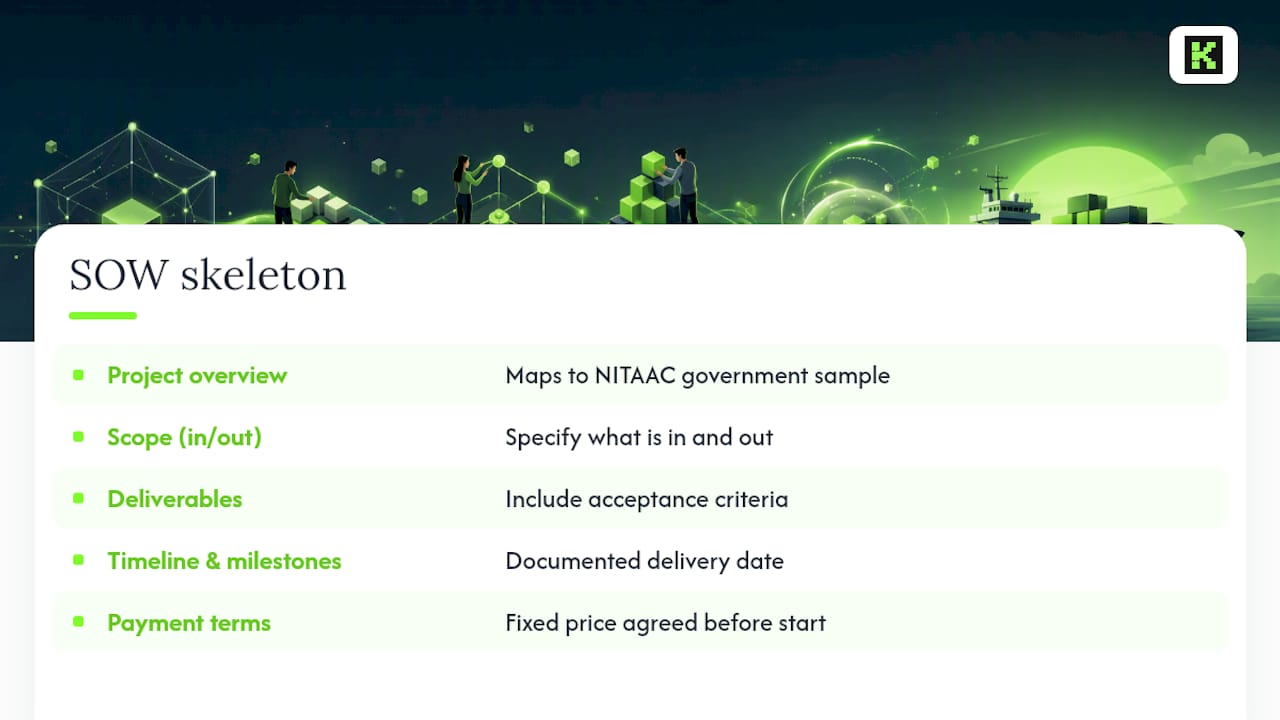
A copyable SOW skeleton follows this order: project overview, scope (in and out), deliverables with acceptance criteria, timeline and milestones, payment terms, roles and responsibilities, change order process, and constraints and assumptions, closing with signature blocks and an MSA reference clause. That order maps to how NITAAC’s government SOW sample is built, and it works equally well for commercial projects.
Tailor the level of detail to the delivery model. Fixed-price projects need maximum specificity in scope and acceptance criteria, since there’s no room to renegotiate mid-build without a formal change order. Phased projects can define phase one in full detail and phase two at a higher level, refined once phase one wraps. Agile engagements still need an SOW, but it should define acceptance at the epic or release level rather than locking every sprint.
Every fixed-price engagement should have a fixed price agreed before work starts, a documented delivery date, one accountable contact for the life of the project, and senior engineers handling the build directly rather than routing through management layers. The handover documentation at project close mirrors the SOW’s own deliverables list, so acceptance and delivery match on paper and in practice.
What Legal and Compliance Issues Show Up in Software SOWs?
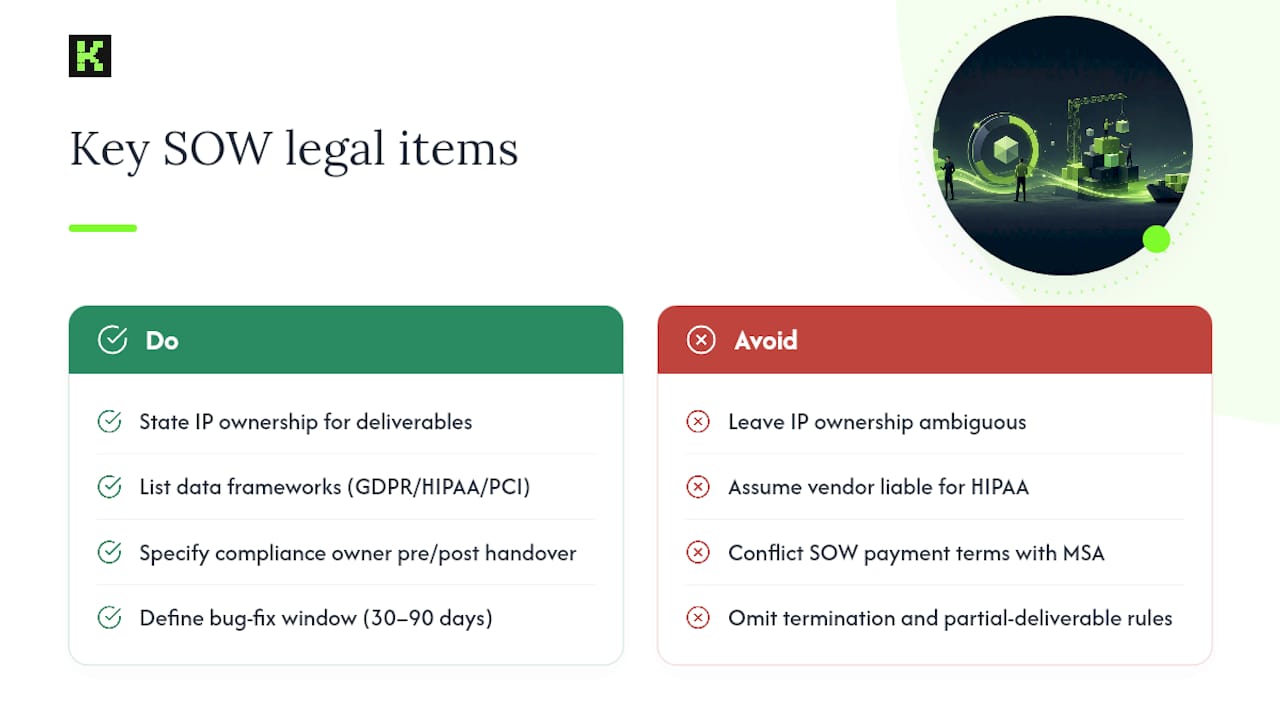
Intellectual property ownership is the clause most often glossed over and most often disputed later. State plainly who owns the code, the designs, and any pre-existing components the vendor brings into the project. Work-for-hire language should live in the MSA, but the SOW should confirm which specific deliverables fall under it.
Data handling deserves its own line item, especially for projects touching customer records, health data, or payment information. Name the applicable framework, GDPR, HIPAA, PCI DSS, whichever applies, and specify who’s responsible for compliance during development versus after handover. A vendor building a healthcare app isn’t automatically liable for HIPAA compliance unless the SOW says so; ambiguity here creates real exposure for both sides.
Liability caps and warranty periods usually live in the MSA, but the SOW should state whether a post-launch bug-fix window is included in the fixed price or billed separately. Thirty to ninety days is common practice, though the actual term depends entirely on what both parties negotiate. Termination clauses matter too: if either party can walk away mid-project, the SOW should specify what happens to partial deliverables and payments already made.
Jurisdiction and dispute resolution mechanisms belong in the MSA, but the SOW should never contradict them. A common and costly mistake is drafting a project-specific SOW with payment terms that conflict with the MSA’s stated currency, payment window, or late-fee structure. Cross-check the two documents line by line before signing, not after a dispute forces the comparison.
How Do Software SOWs Differ Across Industries?
A healthcare software SOW carries compliance weight that a marketing website SOW never touches. Expect explicit HIPAA-related data handling clauses, audit trail requirements for any feature touching patient records, and acceptance criteria that include security testing sign-off, not just functional testing.
Fintech and payments projects add PCI DSS scope language, third-party payment processor integration clauses, and often a separate security review milestone before final acceptance. Change orders in this space tend to require additional compliance re-review, which should be written into the change order template itself rather than discovered mid-negotiation.
E-commerce SOWs typically emphasize third-party integrations: payment gateways, inventory systems, shipping APIs. Scope sections here need to explicitly separate “we build the integration” from “we’re responsible for the third-party service’s uptime,” since that line gets blurred constantly.
Enterprise internal tools, the kind built for a single company’s internal use rather than public release, often skip formal SLAs entirely in favor of an internal support agreement referenced inside the SOW itself. Government and public-sector software projects lean hardest on procurement-grade rigor: the NITAAC template and similar FAA-hosted templates reflect that, with far more prescriptive acceptance language than most commercial templates use by default. If you’re bidding on public-sector work, borrow that rigor even if your own template usually runs leaner.
When Is Paid Discovery Worth It, and When Can You Scope It Yourself?
For projects under roughly six weeks of build time, a founder-written scope document is often enough, especially with AI-assisted drafting tools closing obvious gaps. Past that complexity threshold, or with more than two integrations, paid discovery earns its cost. Pangea makes the same case: a development-ready spec with a real problem statement and prioritized feature list prevents the vague estimates that turn into disputes later.
— Ints
Kello Solutions: How We Help With SOW-Backed Fixed-Price Delivery
A strong SOW is only as good as the team executing against it. Kello Solutions builds every project, mobile, web, backend, or SaaS, around the same protections this article just walked through: a fixed price agreed before work starts, a stated delivery date, and one accountable contact who stays with you from kickoff to handover.
There is often no management layer between you and the people writing your code. Some engagements are staffed by senior engineers directly, which can lead to fast response times. If you need a full custom build, the services page covers Mobile Development, Web Development, Backend Development, SaaS Development, and Custom Software & Integrations. If you want a faster, lower-cost path to a first release, the MVP builder starts at €89 one-off and gets you a working product to validate before committing to a larger SOW. Reach out through the services page to scope your project and get a fixed price in writing.
Sources
FAQ
What Is the Difference Between an SLA and an SOW?
An SOW defines a specific project’s scope, deliverables, and timeline, while an SLA defines ongoing performance standards like uptime or support response times. Most projects use an SOW for the build and, if needed, a separate SLA for post-launch support.
What Is an Example of a Statement of Work?
A typical example covers a mobile app login feature: the deliverable is a working authentication screen, the acceptance criteria specify error handling and session behavior, and payment releases once those criteria pass testing. Government samples like the NITAAC template show the full structure in detail.
What Is the Difference Between an MSA and an SOW?
The MSA is the umbrella legal agreement covering liability, IP ownership, and confidentiality across an entire relationship. The SOW defines the specific work, deliverables, and payment terms for one engagement, and typically incorporates the MSA by reference rather than restating its terms.
What’s the Difference Between an SOW and a Contract?
A contract is the general legal term for the binding agreement between two parties, while an SOW is one component of it, usually paired with an MSA. Together, the MSA and its SOWs form the complete contract governing the work.
Does Kello Solutions Provide a SOW for Every Project?
Yes. Every fixed-price engagement includes a documented scope, delivery date, and payment structure agreed before work begins, reviewed with your single point of contact. Details vary by project, so current scope and pricing are available through the services page.